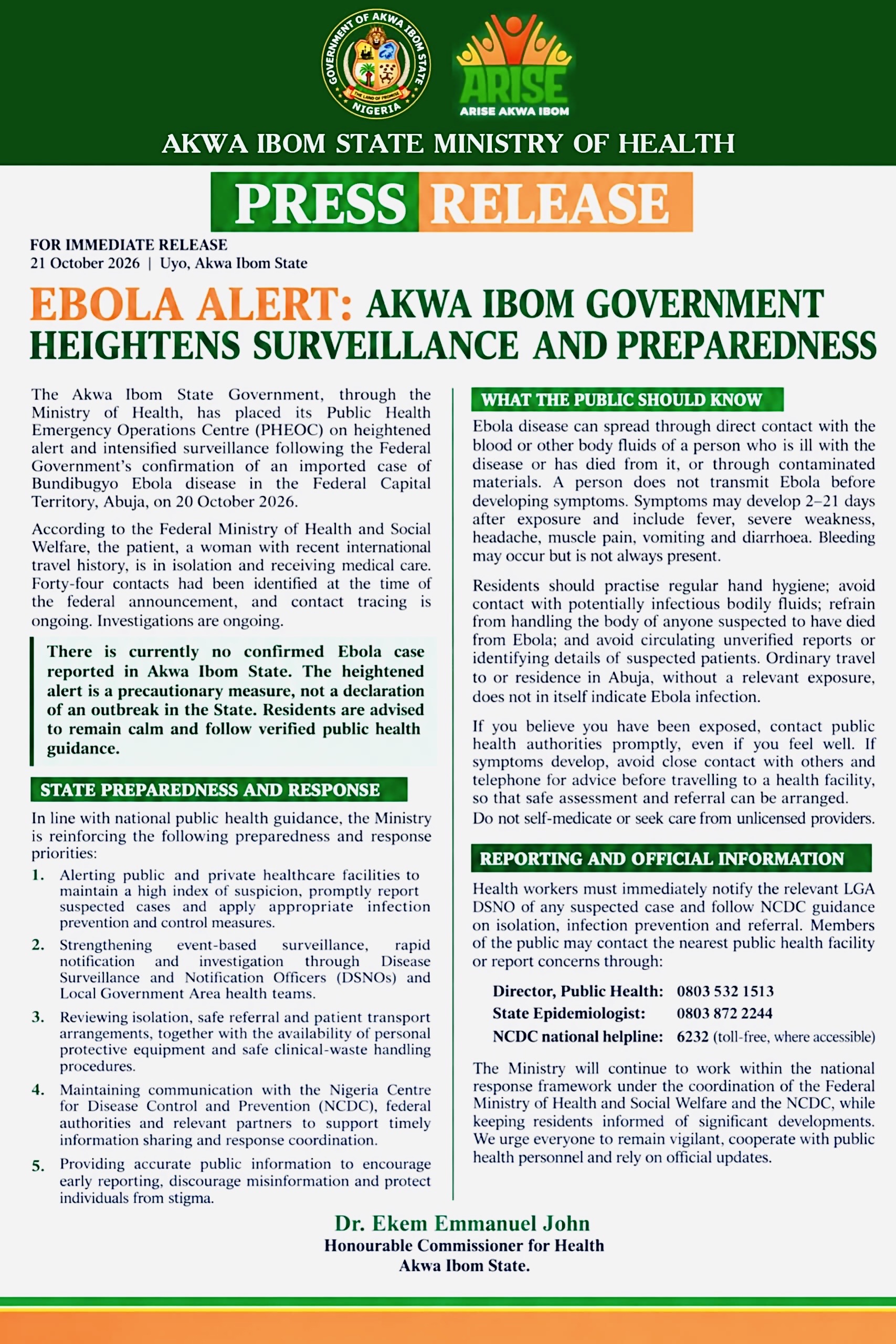
The Akwa Ibom State Government has heightened disease surveillance and placed its Public Health Emergency Operations Centre on alert following the confirmation of an Ebola case in Abuja.
In a statement dated October 21, 2026, the Commissioner for Health, Dr Ekem Emmanuel John, said no confirmed Ebola case had been reported in Akwa Ibom State. He explained that the heightened alert was a precautionary measure, not a declaration of an outbreak in the state.
The ministry urged residents to remain calm, follow verified public health guidance and cooperate with health personnel.
The alert followed the Federal Government’s announcement on October 20 that a woman with recent international travel history had tested positive for Ebola in the Federal Capital Territory. The patient was in isolation and receiving medical care, while 44 close contacts had been identified at the time of the federal announcement.
State strengthens preparedness
According to the state health ministry, public and private healthcare facilities are being alerted to promptly identify and report suspected cases and apply appropriate infection prevention and control measures.
The government is also strengthening surveillance, rapid notification and investigation through Disease Surveillance and Notification Officers and local government health teams.
Other measures include reviewing isolation facilities, safe referral and patient transport arrangements, the availability of personal protective equipment and procedures for handling clinical waste safely.
The ministry said it would maintain communication with the Nigeria Centre for Disease Control and Prevention (NCDC), federal authorities and relevant partners to support timely information sharing and a coordinated response.
It also pledged to provide accurate public information, encourage early reporting, discourage misinformation and protect individuals from stigma.
What residents should know
The advisory explained that Ebola can spread through direct contact with the blood or other body fluids of a person who is ill with the disease or has died from it, as well as through contaminated materials. People do not transmit Ebola before developing symptoms.
Symptoms may appear between two and 21 days after exposure and include fever, severe weakness, headache, muscle pain, vomiting and diarrhoea. Bleeding may occur but is not always present.
Residents were advised to practise regular hand hygiene, avoid contact with potentially infectious body fluids and refrain from handling the body of anyone suspected to have died from Ebola.
The ministry also cautioned against circulating unverified reports or identifying details of suspected patients. It stressed that ordinary travel to, or residence in, Abuja without a relevant exposure does not itself indicate Ebola infection.
Report exposure and seek advice early
Anyone who believes they may have been exposed should contact public health authorities promptly, even if they feel well, the ministry advised.
If symptoms develop, affected persons should avoid close contact with others and telephone for advice before travelling to a health facility so that safe assessment and referral can be arranged. Residents were urged not to self-medicate or seek care from unlicensed providers.
Health workers were directed to immediately notify the relevant Local Government Area Disease Surveillance and Notification Officer of suspected cases and follow NCDC guidance on isolation, infection prevention and referral.
Official reporting contacts
The ministry listed the following contacts for concerns and reporting:
- Director, Public Health: 0803 532 1513
- State Epidemiologist: 0803 872 2244
- NCDC national helpline: 6232 (toll-free, where accessible)
The ministry said it would continue working within the national response framework and keep residents informed of significant developments.
Source: Akwa Ibom State Ministry of Health press release, October 21, 2026. See also the Federal Ministry of Health and Social Welfare announcement.